General information about Tae Kwon Do
and the Han Moo Kwan Club
Introduction:
The martial art known as Tae Kwon Do is rooted in ancient Korean fighting art
traditions and means “The Way of the Feet and Hands.” The style of Tae
Kwon Do practiced by our Club is called Han Moo Kwan Tae Kwon Do referring to
the name of its school. It is a military form of Tae Kwon Do. Han Moo Kwan
was founded in 1954 in Seoul, Korea. As with most of the original 9 Kwans
(schools) the masters were heavily influenced by their training in Japanese
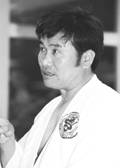
Karate. Mr. Ui Jung Kim, sixth-degree black belt, was our founding Chief
Instructor. He passed away in January of 1999. The foundation of our
techniques includes strikes, kicks, blocks, as well as joint locks and
take-downs/throws. We also practice self-defense, sparring, combat, and hyung
(commonly called “forms” in English, and “kata” in Japanese).
Combining a club atmosphere with the teaching and learning of a potentially
deadly fighting art requires the instructors to maintain the right balance of
attitude, creating an environment which promotes a friendly exchange of ideas
while modeling the necessary intensity and a commitment to safety. Over time,
the club setting tends to foster close friendships which further enhance the
spirit of the club. This often results in club members socializing outside of
class.
The Art Form:
There were many forms of Tae Kwon Do developed in Korea, promoted through a
variety of schools called “kwans”. Han Moo Kwan is one of nine original
families within Tae Kwon Do and has a somewhat colorful background. Han Moo Kwan
philosophy and strategies are based on an honorable Fighting art with its origins
dating back hundreds of years. According to Mr. Kim, it was selected as a primary
form taught to the military and was forced to go underground when Korea
experienced times of political change.
Our Han Moo Kwan Club retains the traditional style and philosophy taught to
Mr. Kim in the 1950s, before the unification of the Kwans (schools) under a
shared style defined by the Kukkiwon (the current official headquarters of
taekwondo). World TaeKwonDo (WT), one of the largest and most well-known
Tae Kwon Do organizations, follows the Kukkiwon standard and markets its training
toward younger students desiring to achieve through competition (sport). Our
Han Moo Kwan style addresses the needs of the adult who wishes to practice a
power form designed for personal combat. This fighting art is used strictly
for self-defense using only bare hands and feet, no weaponry, to fend off attackers.
The physical (body) aspect of our training provides the student with an
aerobic and anaerobic workout. Other benefits include increased flexibility,
improved balance, and strength training. The mental (mind) aspect of the art
form teaches power and focus. Other benefits include stress reduction and
increased self-confidence. The discipline of blending these body-mind
skills is based on a respect for oneself and others.
The principles of the Han Moo Kwan art form are close the distance, get off the line,
protect yourself at all times, keep it simple, fight as if your life depends on it
(doing whatever it takes to defend your life), strike or block for damage
(every movement does damage) to end the altercation quickly, focus on the opponent
not just the weapon, be grounded at all times, and use external energy. The
strategies used to execute the principles are proper stances, structural alignment,
linear strikes and short strikes. The most common tactics / techniques used are
strikes, kicks, and blocks. However, the art form also incorporates other tactics
such as take downs / throws, joint locks/arm bars, traps/pins, grabs/crushes,
and nerves/pressure points.
Our Han Moo Kwan Club uses traditional rankings with a limited set of belt colors
including white, green, blue, brown, and black (in various degrees).
Approximately every six months, students demonstrate their skills through
formal testing. They are then awarded their new rank.
The Chief Instructor reports directly to the Club President and is responsible to
the Board Of Directors for maintaining the integrity of the art form.
The Club Atmosphere:
The club atmosphere was developed and set by Mr. Kim and Bob Rainie. They
intentionally dropped most of the formalities found in traditional Korean Tae
Kwon Do schools. They also made sure that the club had a social side, so that
it was not just a martial arts studio. Mr. Kim suggested dropping the use of
Korean terminology and constant bowing so the club workouts would be more like
friends getting together than students working under an instructor.
The Club acts as a non-profit organization. All class instructors are black belts
and receive no money for instruction but are “paid” in different ways. Part of
this approach revolves around “giving back” to the community which is in-line
with Mr. Kim's philosophy about sharing the art form. In our case, individuals
reaching the rank of black belt are expected to give back to those members just
starting out.
Student dues are kept in balance with the club's needs. The dues are used to pay
for venues, equipment, insurance, and social activities, etc. During periods of
high attendance, any overabundance of moneys are kept in reserve or donated to
local non-profit clubs/groups who are dedicated to supporting our local community
(e.g., women's shelters and food banks, etc.). This is in alignment with our goal
to be seen as a positive member of our society.
To help facilitate a club atmosphere, events are planned throughout the year such
as picnics in the summer for club members to interact in a relaxed, social
environment. Also, after students are awarded their new rank, they are treated
to a celebration dinner.
Club Officers from the beginning have been essential in running and building the
Han Moo Kwan Tae Kwon Do Club. The Club Officers are the liaisons with any corporate
sponsor, Han Moo Kwan Association Board Of Directors and the community. They are
the forerunners in promoting and ensuring longevity of the Han Moo Kwan Tae Kwon Do
Club and art form.
Although the art form is often seen as “harsh”, the club retains its
underlying goal of building community. Studied by men and women, the young
and not so young, a strong sense of camaraderie develops among club members.